Loading...
Searching...
No Matches
morph::tui::LoopExecutor Class Referencefinal
Runs every posted task in a later turn of one core::net::EventLoop, with this executor current. More...
#include <loop_executor.hpp>
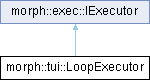
Inheritance diagram for morph::tui::LoopExecutor:
Public Member Functions | |
| LoopExecutor (::core::net::EventLoop &loop) | |
| ~LoopExecutor () override | |
| Destroys the executor; tasks it posted that have not run yet are dropped when the loop reaches them. | |
| LoopExecutor (LoopExecutor const &)=delete | |
| LoopExecutor & | operator= (LoopExecutor const &)=delete |
| LoopExecutor (LoopExecutor &&)=delete | |
| LoopExecutor & | operator= (LoopExecutor &&)=delete |
| void | post (std::function< void()> task) override |
Queues task for a later turn of the loop. | |
| Public Member Functions inherited from morph::exec::IExecutor | |
| IExecutor (const IExecutor &)=delete | |
| IExecutor & | operator= (const IExecutor &)=delete |
| IExecutor (IExecutor &&)=delete | |
| IExecutor & | operator= (IExecutor &&)=delete |
| virtual bool | isSerial () const noexcept |
| Whether this executor runs one task at a time, each after the tasks posted before it: a strand, a GUI loop, a pumped MainThreadExecutor. | |
| ::core::async::IExecutor & | coreExecutor () noexcept |
| This executor as a core-cpp executor: the identity an core::async::ExecutorScope names. | |
Detailed Description
Runs every posted task in a later turn of one core::net::EventLoop, with this executor current.
The TUI frontend's reactive Runtime is owned by one, and every BridgeHandler an application builds receives it as its callback executor, so model replies, timers, sockets and input all run on the thread that turns the loop. post() may be called from any thread. A task still queued when the executor is destroyed is dropped, and a task that throws is logged and does not stop the loop.
Destroy it on the thread that turns the loop, between turns or from inside one of its own tasks, never from another thread: a task already running there would go on using an owner (the reactive Runtime) that is gone. Nothing guards against that, because a lock held across a task would deadlock a task that destroys its own executor.
Definition at line 29 of file loop_executor.hpp.
Constructor & Destructor Documentation
◆ LoopExecutor()
|
explicit |
- Parameters
-
loop The loop to post to. Borrowed: it must outlive this executor.
Member Function Documentation
◆ post()
|
overridevirtual |
Queues task for a later turn of the loop.
- Parameters
-
task What to run; inside it exec::runningOn(*this) holds.
Implements morph::exec::IExecutor.
The documentation for this class was generated from the following file:
- morph/tui/loop_executor.hpp
