Loading...
Searching...
No Matches
morph::ui::TableWidget Class Referenceabstract
Keyed rows under column headers, with selection and activation by key. More...
#include <backend.hpp>
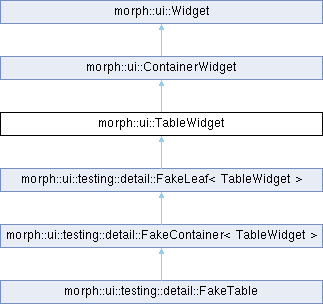
Inheritance diagram for morph::ui::TableWidget:
Public Member Functions | |
| virtual void | setColumns (std::vector< TableColumn > const &columns)=0 |
| Sets the column headers and widths. | |
| virtual void | setShowHeader (bool shown)=0 |
| Sets whether the header row is drawn. | |
| virtual void | setSelectionMode (SelectionMode mode)=0 |
| Sets how many rows the user can select. | |
| virtual void | setRowKey (Widget &row, Key const &key)=0 |
| Tells the table which key a row stands for; called once per row, right after it is built. Marks the row when its key is requested. | |
| virtual void | setRowTone (Widget &row, std::optional< Tone > tone)=0 |
| Sets a row's tone; called after setRowKey for a row given a tone, and on every change. | |
| virtual void | setSelection (std::vector< Key > const &keys)=0 |
| Requests the rows with these keys, and marks those it has. Never calls the onSelectionChange handler. | |
| virtual void | setOnSelectionChange (std::function< void(std::vector< Key >)> onSelectionChange)=0 |
| Sets what a user's selection change calls, with the keys of every row then selected. | |
| virtual void | setOnActivate (std::function< void(Key)> onActivate)=0 |
| Sets what activating a row (Enter or a double click) calls, with its key. | |
| virtual void | setRealizedWindow (std::size_t first, std::size_t count, std::size_t total) |
| Tells the backend how many of the table's rows are realized, where, and how many exist in total, so it can size a scrollbar and place leading/trailing space for the rows that are not realized. A backend that never virtualizes (the default for every implementer but a windowed Qt Quick table) never calls setOnVisibleRangeChanged, so this is never called either. | |
| virtual void | setOnVisibleRangeChanged (std::function< void(std::size_t, std::size_t)> onVisibleRangeChanged) |
| Sets what the backend calls when the user scrolls, asking the mount to realize roughly this range of rows next. A backend that never virtualizes leaves this empty; the mount then never dewindows a row. | |
| virtual void | setExistingKeys (std::vector< Key > const &keys) |
| Tells the backend every key currently in the table's data, realized or not – called whenever that set changes (a data change, or a scroll that dewindows or re-realizes a row). A virtualized backend needs this to know a selected key still exists in the data when it has no realized row for it right now (setRowKey alone cannot say that, since it is only ever called for a realized row): without it, a backend that reconstructs "does this key still exist" purely from its realized children would silently drop a selected key's membership the moment its row scrolls out of view. A backend that never virtualizes may ignore this – every key it cares about already has a realized row, by definition, so setRowKey alone already tells it everything this call would add. | |
| Public Member Functions inherited from morph::ui::ContainerWidget | |
| virtual void | moveChild (Widget &child, std::size_t index)=0 |
Moves child to position index: it is removed, then inserted before the child now at index. | |
| Public Member Functions inherited from morph::ui::Widget | |
| Widget (Widget const &)=delete | |
| Widget & | operator= (Widget const &)=delete |
| Widget (Widget &&)=delete | |
| Widget & | operator= (Widget &&)=delete |
| virtual void | setVisible (bool visible)=0 |
| Shows or hides the widget and everything inside it. | |
| virtual void | setEnabled (bool enabled)=0 |
| Enables or disables input on the widget and everything inside it. | |
| virtual void | setLayout (LayoutHints const &hints)=0 |
| Sets the size request. | |
| virtual void | setDragKey (std::optional< Key > const &key)=0 |
Makes the widget draggable, carrying key, or not draggable. | |
| virtual void | setDropHandler (std::function< bool(Key const &)> accepts, std::function< void(Key)> onDrop)=0 |
| Makes the widget a drop target. | |
| virtual void | setAccessibleName (std::string_view name)=0 |
| Sets the name assistive technology reads for the widget. | |
| virtual void | setAccessibleRole (std::string_view role)=0 |
| Sets the role assistive technology announces for the widget. | |
| virtual void | setTestId (std::string_view testId)=0 |
| Sets the stable identifier an automated test finds the widget by. | |
| virtual void | setTooltip (std::string_view text)=0 |
| Sets the text shown while the pointer rests on the widget. | |
| virtual void | setSurface (std::string_view surface)=0 |
| Styles the widget and everything inside it with a named token set of the theme. | |
| virtual void | setKeys (std::vector< std::string > const &chords, std::function< void(std::string)> onChord)=0 |
| Declares the keyboard chords the widget handles while focus is inside it. | |
| virtual void | focus ()=0 |
| Moves keyboard focus to the widget. | |
| virtual void | setOnHover (std::function< void()> onHover) |
Calls onHover each time the pointer comes to rest over the widget. A backend without a pointer, or one that does not report hovering, keeps the default, which never calls it: hovering is a hint, such as a prefetch, never something a widget relies on. | |
Detailed Description
Keyed rows under column headers, with selection and activation by key.
Its children are the rows, each a horizontal stack whose children are the cells in column order. A hidden cell keeps its column: the cells after it stay under their own headers.
Selection is kept by key. The widget keeps the keys last requested by setSelection or selected by the user, and marks the current rows that have one of them: a key with no row marks nothing and stays requested, so a row that arrives with it later is marked, a row that goes is unmarked, and a reorder keeps the marks. Rows and selection may therefore arrive in either order. The selection mode limits what the user can select, not what setSelection marks.
A user's selection replaces the requested keys, and the widget shows it whether or not the application binds the selection. onSelectionChange then gets exactly the keys of the existing rows now selected, in any mode: a key still waiting for its row is dropped by a user's change, while setSelection keeps it waiting. It reports the user's selections only: no setter, and no row arriving or going, calls it.
Definition at line 462 of file backend.hpp.
Member Function Documentation
◆ setColumns()
|
pure virtual |
Sets the column headers and widths.
- Parameters
-
columns The columns, in order.
Implemented in morph::ui::testing::detail::FakeTable.
◆ setShowHeader()
|
pure virtual |
Sets whether the header row is drawn.
- Parameters
-
shown false suits several tables sharing one visual header.
Implemented in morph::ui::testing::detail::FakeTable.
◆ setSelectionMode()
|
pure virtual |
Sets how many rows the user can select.
- Parameters
-
mode None, one, or any number.
Implemented in morph::ui::testing::detail::FakeTable.
◆ setRowKey()
Tells the table which key a row stands for; called once per row, right after it is built. Marks the row when its key is requested.
- Parameters
-
row One of this table's rows. key The row's key.
Implemented in morph::ui::testing::detail::FakeTable.
◆ setRowTone()
|
pure virtual |
Sets a row's tone; called after setRowKey for a row given a tone, and on every change.
- Parameters
-
row One of this table's rows. tone The tone, or none.
Implemented in morph::ui::testing::detail::FakeTable.
◆ setSelection()
|
pure virtual |
Requests the rows with these keys, and marks those it has. Never calls the onSelectionChange handler.
- Parameters
-
keys The selected keys.
Implemented in morph::ui::testing::detail::FakeTable.
◆ setOnSelectionChange()
|
pure virtual |
Sets what a user's selection change calls, with the keys of every row then selected.
- Parameters
-
onSelectionChange The handler; empty does nothing.
Implemented in morph::ui::testing::detail::FakeTable.
◆ setOnActivate()
|
pure virtual |
Sets what activating a row (Enter or a double click) calls, with its key.
- Parameters
-
onActivate The handler; empty does nothing.
Implemented in morph::ui::testing::detail::FakeTable.
◆ setRealizedWindow()
|
inlinevirtual |
Tells the backend how many of the table's rows are realized, where, and how many exist in total, so it can size a scrollbar and place leading/trailing space for the rows that are not realized. A backend that never virtualizes (the default for every implementer but a windowed Qt Quick table) never calls setOnVisibleRangeChanged, so this is never called either.
- Parameters
-
first The view index of the first realized row. count How many rows are realized, starting at first. total How many rows the table's data has, realized or not.
Reimplemented in morph::ui::testing::detail::FakeTable.
Definition at line 506 of file backend.hpp.
◆ setOnVisibleRangeChanged()
|
inlinevirtual |
Sets what the backend calls when the user scrolls, asking the mount to realize roughly this range of rows next. A backend that never virtualizes leaves this empty; the mount then never dewindows a row.
- Parameters
-
onVisibleRangeChanged The handler, with the first view index and how many rows are wanted from there; empty does nothing.
Reimplemented in morph::ui::testing::detail::FakeTable.
Definition at line 516 of file backend.hpp.
◆ setExistingKeys()
|
inlinevirtual |
Tells the backend every key currently in the table's data, realized or not – called whenever that set changes (a data change, or a scroll that dewindows or re-realizes a row). A virtualized backend needs this to know a selected key still exists in the data when it has no realized row for it right now (setRowKey alone cannot say that, since it is only ever called for a realized row): without it, a backend that reconstructs "does this key still exist" purely from its realized children would silently drop a selected key's membership the moment its row scrolls out of view. A backend that never virtualizes may ignore this – every key it cares about already has a realized row, by definition, so setRowKey alone already tells it everything this call would add.
- Parameters
-
keys Every key currently in the table's data, in no particular order.
Definition at line 529 of file backend.hpp.
The documentation for this class was generated from the following file:
- morph/ui/backend.hpp
