Loading...
Searching...
No Matches
morph::session::SigningAuthorizer Class Reference
IAuthorizer that authenticates via a signed Context::token. More...
#include <session_auth.hpp>
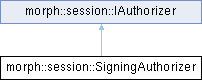
Inheritance diagram for morph::session::SigningAuthorizer:
Public Types | |
| using | Policy |
| Optional per-request policy over verified claims. | |
Public Member Functions | |
| SigningAuthorizer (std::string secret, MacFunction mac=hmacSha256, Clock clock=systemClockMs, Policy policy={}) | |
| Constructs the authorizer. | |
| bool | authorize (const Context &ctx, std::string_view modelType, std::string_view actionType) const override |
Allows the call iff ctx carries a valid token the policy admits. | |
| std::optional< std::string > | authenticate (const Context &ctx) const override |
| Returns the verified principal so the server can make it authoritative. | |
| Admission | admit (const Context &ctx, std::string_view modelType, std::string_view actionType) const override |
Verifies ctx's token once, then asks authenticate and authorize as the default admit does. | |
| Public Member Functions inherited from morph::session::IAuthorizer | |
| virtual bool | authorizeInstance (const Context &ctx, std::string_view modelType, std::string_view actionType, std::uint64_t modelId, std::string_view ownerPrincipal) const |
| Optional per-**instance** authorization hook — the multi-tenant gate. | |
| virtual bool | authorizeRegister (const Context &ctx, std::string_view modelType) const |
| Optional gate on model creation — bounds who may create an instance. | |
Detailed Description
IAuthorizer that authenticates via a signed Context::token.
authorize returns true only for a token with a valid signature and unexpired claims (and, if a policy is supplied, one the policy admits). authenticate returns the verified principal so RemoteServer makes it authoritative. Install it on the server:
auto authz = std::make_shared<morph::session::SigningAuthorizer>(sharedSecret);
auto server = std::make_shared<morph::backend::RemoteServer>(pool, authz);
Definition at line 523 of file session_auth.hpp.
Member Typedef Documentation
◆ Policy
Initial value:
std::function<bool(const SessionToken& claims, std::string_view modelType, std::string_view actionType)>
Verified claims carried by a session token.
Definition session_auth.hpp:289
Optional per-request policy over verified claims.
Receives the verified token plus the target ids; return false to deny. The action id is empty for the instances, schemas and deregister envelopes, and the model type id is empty for deregister – see IAuthorizer::authorize's own doc comment for why, and handle those cases explicitly rather than letting them reach a default arm. The default (empty) admits any validly-signed, unexpired token.
Definition at line 533 of file session_auth.hpp.
Constructor & Destructor Documentation
◆ SigningAuthorizer()
|
inlineexplicit |
Constructs the authorizer.
- Parameters
-
secret Shared secret used to verify tokens. mac MAC primitive; defaults to hmacSha256. Forwarded into this authorizer's TokenVerifier and invoked for its whole lifetime, so anything the callable refers to must outlive it. clock Time source (ms since epoch) for expiry; defaults to system time. Stored and invoked for this authorizer's whole lifetime, so anything the callable refers to must outlive it. policy Optional per-request policy over verified claims. Stored and invoked on the same terms as clock.
Definition at line 567 of file session_auth.hpp.
Member Function Documentation
◆ authorize()
|
inlinenodiscardoverridevirtual |
Allows the call iff ctx carries a valid token the policy admits.
- Parameters
-
ctx Per-call session (its token is verified). modelType Target model type id (passed to the policy). actionType Target action type id (passed to the policy).
- Returns
- true to allow dispatch, false to reject.
Implements morph::session::IAuthorizer.
Definition at line 577 of file session_auth.hpp.
◆ authenticate()
|
inlinenodiscardoverridevirtual |
Returns the verified principal so the server can make it authoritative.
- Parameters
-
ctx Per-call session (its token is verified).
- Returns
- The token's principal if valid, else nullopt.
Reimplemented from morph::session::IAuthorizer.
Definition at line 590 of file session_auth.hpp.
◆ admit()
|
inlinenodiscardoverridevirtual |
Verifies ctx's token once, then asks authenticate and authorize as the default admit does.
Both are still called through the vtable, so a subclass that overrides either keeps its own decision: a carve-out that admits a call without a token, or a rule that refuses more than the token does. While this call runs, SigningAuthorizer's own authenticate and authorize answer from the one verification instead of verifying again, so a token is judged against one clock reading. Nothing outlives the call.
- Parameters
-
ctx Per-call session (its token is verified). modelType Target model type id (passed to authorize). actionType Target action type id (passed to authorize).
- Returns
- authorize's answer and authenticate's, from one verification.
Reimplemented from morph::session::IAuthorizer.
Definition at line 612 of file session_auth.hpp.
The documentation for this class was generated from the following file:
- morph/session/session_auth.hpp
