Loading...
Searching...
No Matches
morph::ui::Frontend Class Referenceabstract
A frontend: owns an event loop and a renderer, and runs one source's screens. More...
#include <frontend.hpp>
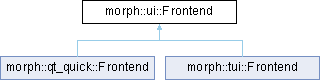
Inheritance diagram for morph::ui::Frontend:
Public Member Functions | |
| Frontend (Frontend const &)=delete | |
| Frontend & | operator= (Frontend const &)=delete |
| Frontend (Frontend &&)=delete | |
| Frontend & | operator= (Frontend &&)=delete |
| virtual std::string_view | name () const =0 |
| The name selectFrontend matches. | |
| virtual int | run (AppSource &source)=0 |
Builds the runtime and its executor, opens source, mounts the app shell and drives the loop until AppContext::quit. | |
Detailed Description
A frontend: owns an event loop and a renderer, and runs one source's screens.
Definition at line 175 of file frontend.hpp.
Member Function Documentation
◆ name()
|
nodiscardpure virtual |
The name selectFrontend matches.
- Returns
- The name.
Implemented in morph::qt_quick::Frontend, and morph::tui::Frontend.
◆ run()
|
pure virtual |
Builds the runtime and its executor, opens source, mounts the app shell and drives the loop until AppContext::quit.
Tears down in reverse: the screens, then the source's connections, then the runtime, then the loop and the toolkit. A frontend leaves the first two to runApp, which fixes that order, and keeps the rest by declaring its members or locals in construction order.
- Parameters
-
source Where the screens and the models are; it outlives the call.
- Returns
- The exit code passed to quit; a frontend may also end the run on its own (end of input, an interrupt) with a code it documents.
Implemented in morph::qt_quick::Frontend, and morph::tui::Frontend.
The documentation for this class was generated from the following file:
- morph/ui/frontend.hpp
