Loading...
Searching...
No Matches
morph::offline::IReplayLedger Struct Referenceabstract
Interface for an op-id-keyed exactly-once replay ledger. More...
#include <replay_ledger.hpp>
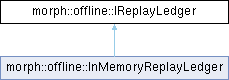
Inheritance diagram for morph::offline::IReplayLedger:
Public Member Functions | |
| std::optional< std::string > | lookup (std::string_view scope, std::string_view opId) const |
Reports whether opId within scope has already been decided. | |
| void | record (std::string_view scope, std::string_view opId, std::string payload) |
Records that opId within scope has been decided, with payload attached. | |
| ::morph::async::Completion< std::optional< std::string > > | lookup (::morph::exec::IExecutor &replyExec, std::string_view scope, std::string_view opId) const |
Reports whether opId within scope has already been decided, looked up on the ledger's owner and delivered on replyExec. | |
Protected Member Functions | |
| virtual ::morph::async::Completion< std::optional< std::string > > | askLookup (::morph::exec::IExecutor &replyExec, std::string scope, std::string opId) const |
| What lookup(replyExec, scope, opId) asks. The default looks up where it is called, for an implementation with no owner; one with an owner looks up there. | |
| virtual std::optional< std::string > | doLookup (std::string_view scope, std::string_view opId) const =0 |
| Storage hook for lookup(). | |
| virtual void | doRecord (std::string_view scope, std::string_view opId, std::string payload)=0 |
Storage hook for record(). Must be a no-op if scope/ already recorded (first-write-wins). | |
Detailed Description
Interface for an op-id-keyed exactly-once replay ledger.
Answers one question — "has this operation id already been applied?" — for a host that must dedup a retried write against one it already committed. One framework seam in place of a near-identical table each host would otherwise hand-write. A host either stores a result and replays it verbatim on a hit ("response-replay"), or stores nothing and reports only that the op was seen ("skip-only", as examples/bookmarks' import path does). Both are the same mechanism with a different caller-side interpretation of the stored payload — see lookup()'s own doc comment — so there is exactly one interface here, not two.
- Why the framework cannot supply the storage
- Every existing occurrence stores its ledger row in the same database and the same transaction as the write it guards, so the check-then-set commits atomically with the operation's effect — see record()'s doc comment. include/morph has no dependency on any SQL library, so it cannot open that connection or join that transaction. What it can supply is the contract: the shape every implementation must have, and a conformance suite (tests/replay_ledger_conformance.hpp) any implementation can be run against. The table itself stays app-side, per rung, exactly as before.
- No base class for consumers
- A model holds (or is handed) an IReplayLedger&; it never derives from one. Every existing occurrence is a free function or a plain member on the model, not a base class — a design that required inheriting from this interface would be un-adoptable by every one of them.
Definition at line 47 of file replay_ledger.hpp.
Member Function Documentation
◆ lookup() [1/2]
|
inlinenodiscard |
Reports whether opId within scope has already been decided.
- What a hit means is the caller's decision, not this interface's
- The returned string is whatever record() stored alongside the id. A response-replay consumer (a move or a money transfer whose retry must see the original answer) stores its result's serialised form and, on a hit, returns that string verbatim instead of re-running the operation. A skip-only consumer (bookmarks' import path, or an at-most-once replay of queued captures) stores an empty payload and, on a hit, reports "already applied, nothing to return" without ever looking at the string. Both read exactly the same lookup() — the value type reports the fact, and the layer that calls this decides what a hit means.
- scope
- An opaque caller-chosen partition — the three key shapes the seven occurrences used ((entity_id, op_id), (owner_principal, op_id), a bare op_id) are all this one string plus the id, with the bare-key case simply passing an empty scope. Two calls with the same opId but different scope never collide.
- Empty opId
- Never reported as decided, in every conforming implementation — see record(). An empty id is not an identity, and reporting one "already applied" would make every unkeyed call after the first a silent no-op.
- Parameters
-
scope Caller-chosen partition; empty is a valid, distinct scope. opId The operation id to look up. Empty always reports std::nullopt, regardless of what has been recorded.
- Returns
- The payload recorded with
opId(possibly empty, for a skip-only caller), or std::nullopt if it has not been recorded — oropIdis empty.
Definition at line 82 of file replay_ledger.hpp.
◆ record()
|
inline |
Records that opId within scope has been decided, with payload attached.
- Atomicity is the caller's responsibility, not this interface's
- The framework cannot enforce this — IReplayLedger has no database connection of its own — so it is stated here instead: a conforming implementation MUST let its caller commit this call in the same transaction as the write it guards. An implementation backed by a SQL table does this by operating through the caller's own already-open connection/transaction handle (passed to the implementation at construction), never by opening a connection of its own. Recording outside that transaction reintroduces exactly the defect this ledger exists to prevent: a crash between the write and the record redelivers the operation and it is re-applied.
- Idempotent: first-write-wins
- Recording an
opIdwithinscopethat is already decided is a no-op — the existing payload is kept, payload here is discarded, and no error is raised. This is the same contract morph::journal::IActionLog::append()'s idempotency-key dedup already ships (journal/action_log.hpp's own doc comment: "if an entry with the same key was already recorded, treat the call as a no-op"): a redelivered retry that reaches record() a second time (e.g. because a reply was lost after the first commit) must not overwrite a payload a caller may already have replayed to someone else.
- Empty opId
- A no-op — there is no identity to record against, so lookup() for an empty id must keep reporting std::nullopt regardless of how many times record() is called with one.
- Parameters
-
scope Caller-chosen partition; must match the scope a later lookup() uses to find this entry. opId The operation id being recorded. A no-op if empty. payload Opaque payload to associate with opId; empty for a skip-only caller that only cares whether a hit occurred.
Definition at line 126 of file replay_ledger.hpp.
◆ lookup() [2/2]
|
inlinenodiscard |
Reports whether opId within scope has already been decided, looked up on the ledger's owner and delivered on replyExec.
The form of lookup() for a caller that is not on the ledger's owner. A lookup answered elsewhere cannot be atomic with the record() that follows it; a caller that needs check-then-set atomicity runs both on the owner.
- Parameters
-
replyExec Where the answer is delivered, and where the caller attaches to it. Borrowed: it must outlive the completion. scope Caller-chosen partition; empty is a valid, distinct scope. opId The operation id to look up. Empty always answers std::nullopt.
- Returns
- What lookup(scope, opId) would have returned.
Definition at line 148 of file replay_ledger.hpp.
◆ askLookup()
|
inlinenodiscardprotectedvirtual |
What lookup(replyExec, scope, opId) asks. The default looks up where it is called, for an implementation with no owner; one with an owner looks up there.
- Parameters
-
replyExec Where the answer is delivered. scope Caller-chosen partition. opId The operation id to look up; never empty here.
- Returns
- The payload recorded with
opId, or std::nullopt.
Reimplemented in morph::offline::InMemoryReplayLedger.
Definition at line 167 of file replay_ledger.hpp.
◆ doLookup()
|
nodiscardprotectedpure virtual |
Storage hook for lookup().
- Parameters
-
scope Caller-chosen partition, forwarded verbatim from lookup(). opId The operation id to look up; never empty here – the public wrapper already handled that case.
- Returns
- The payload recorded with
opId, or std::nullopt if none.
Implemented in morph::offline::InMemoryReplayLedger.
◆ doRecord()
|
protectedpure virtual |
Storage hook for record(). Must be a no-op if scope/ already recorded (first-write-wins). opId is
- Parameters
-
scope Caller-chosen partition, forwarded verbatim from record(). opId The operation id being recorded; never empty here – the public wrapper already handled that case. payload Opaque payload to associate with opId.
Implemented in morph::offline::InMemoryReplayLedger.
The documentation for this struct was generated from the following file:
- morph/offline/replay_ledger.hpp
