Loading...
Searching...
No Matches
morph::offline::InMemoryReplayLedger Class Reference
In-memory implementation of IReplayLedger, owned by one executor. More...
#include <replay_ledger.hpp>
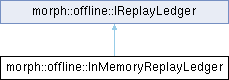
Inheritance diagram for morph::offline::InMemoryReplayLedger:
Public Member Functions | |
| InMemoryReplayLedger (::morph::exec::IExecutor &owner) | |
Constructs an empty ledger belonging to owner. | |
| Public Member Functions inherited from morph::offline::IReplayLedger | |
| std::optional< std::string > | lookup (std::string_view scope, std::string_view opId) const |
Reports whether opId within scope has already been decided. | |
| void | record (std::string_view scope, std::string_view opId, std::string payload) |
Records that opId within scope has been decided, with payload attached. | |
| ::morph::async::Completion< std::optional< std::string > > | lookup (::morph::exec::IExecutor &replyExec, std::string_view scope, std::string_view opId) const |
Reports whether opId within scope has already been decided, looked up on the ledger's owner and delivered on replyExec. | |
Protected Member Functions | |
| std::optional< std::string > | doLookup (std::string_view scope, std::string_view opId) const override |
Looks up opId within scope in the in-memory map. On the owner. | |
| void | doRecord (std::string_view scope, std::string_view opId, std::string payload) override |
Records opId within scope in the in-memory map, unless already present (first-write-wins). On the owner; posted there from anywhere else. | |
| ::morph::async::Completion< std::optional< std::string > > | askLookup (::morph::exec::IExecutor &replyExec, std::string scope, std::string opId) const override |
Looks up on the owner, answered on replyExec. | |
Detailed Description
In-memory implementation of IReplayLedger, owned by one executor.
Suitable for testing and for a host with no durability requirement. Mirrors morph::offline::InMemoryOfflineQueue's shape. Not durable across a process restart, and — since it is not backed by any real transaction — not a stand-in for record()'s atomicity requirement: a real implementation must be backed by the same store and transaction as the write it guards.
- One owner
- The entries belong to the executor given at construction, which must run one task at a time — the executor the guarded writes run on, so a lookup() and the record() after it are one check-then-set. lookup() answers only there; record() runs there, posted from anywhere else; a caller elsewhere looks up through lookup(replyExec, scope, opId).
Definition at line 216 of file replay_ledger.hpp.
Constructor & Destructor Documentation
◆ InMemoryReplayLedger()
|
inlineexplicit |
Constructs an empty ledger belonging to owner.
- Parameters
-
owner The executor every access runs on; must run one task at a time. Borrowed: it must outlive this ledger and run what it posts.
Definition at line 221 of file replay_ledger.hpp.
Member Function Documentation
◆ doLookup()
|
inlinenodiscardoverrideprotectedvirtual |
Looks up opId within scope in the in-memory map. On the owner.
- The two std::string constructions below are deliberate
- They materialise the key purely to probe an ordered map that could take a transparent comparator instead. That was profiled rather than fixed. Measured with clang 22 -O2, a counting operator new, 2e6 iterations per row:
/// -- allocations per lookup() --
/// scope=bookmarks              ( 9) id=CreateSwimlane       (14) : 0.00
/// scope=bookmarks              ( 9) id=CreateSwimlane-0001  (19) : 1.00
/// scope=bookmarks-import-scope (22) id=CreateSwimlane-0001  (19) : 2.00
///
/// -- ns per lookup(), single thread --
/// both inside libstdc++'s 15-char SSO buffer : 28.2 ns
/// both past it                               : 31.6 ns
///
So the cost is real and id-length-dependent. What parks it is the call census, not the size: InMemoryReplayLedger is constructed in one file in this tree, tests/test_replay_ledger.cpp, and in no shipping code at all. The only production IReplayLedger::lookup() call (examples/bookmarks/src/models/bookmark_model.cpp:737, once per ImportBookmarks) runs against BookmarksReplayLedger, whose own doLookup is an ODBC round-trip – next to which 3 ns is not measurable.
It becomes worth fixing the moment a per-request caller of this class appears; the fix is then a transparent comparator on the map, std::map's is_transparent flavour rather than core/registry.hpp's hash-and-equality pair (which serves an unordered_map and does not apply here).
- Parameters
-
scope Caller-chosen partition. opId The operation id to look up; never empty here.
- Returns
- The payload recorded with
opId, or std::nullopt if none.
Implements morph::offline::IReplayLedger.
Definition at line 263 of file replay_ledger.hpp.
◆ doRecord()
|
inlineoverrideprotectedvirtual |
Records opId within scope in the in-memory map, unless already present (first-write-wins). On the owner; posted there from anywhere else.
- Parameters
-
scope Caller-chosen partition. opId The operation id being recorded; never empty here. payload Opaque payload to associate with opId.
Implements morph::offline::IReplayLedger.
Definition at line 274 of file replay_ledger.hpp.
◆ askLookup()
|
inlinenodiscardoverrideprotectedvirtual |
Looks up on the owner, answered on replyExec.
- Parameters
-
replyExec Where the answer is delivered. scope Caller-chosen partition. opId The operation id to look up; never empty here.
- Returns
- The payload recorded with
opId, or std::nullopt.
Reimplemented from morph::offline::IReplayLedger.
Definition at line 290 of file replay_ledger.hpp.
The documentation for this class was generated from the following file:
- morph/offline/replay_ledger.hpp
